

A Story from Stones
Make yourself at home
From glacial remnants to hand-built boundaries, New England’s stone walls trace centuries of labor, livelihood, and lasting beauty.
words by jeff fairfield, professional stonemason
photos by c.a. smith photography & terrapin landscapes
Travel through New England and you’ll inevitably see a stone wall. Through each state, there are immeasurable lengths set along the landscape in varying states of stature.
Often, you’ll see what amounts to a pile of stone that could justifiably be confused as rubble, if it weren’t for the pile’s linear path and the distinct patina of moss and lichen covering the surface.
Despite varying stages of disarray, these stone walls encompass hundreds of thousands of miles across New England and provide insight into the historical colonial development of this region.
Early iterations of stone walls were barely more than the refuse created during the clearing of land for agricultural purposes. European settlers, intent on building farms as a means of surviving and thriving through the formidable Northeast seasons, worked tirelessly to move literal tons of rock.
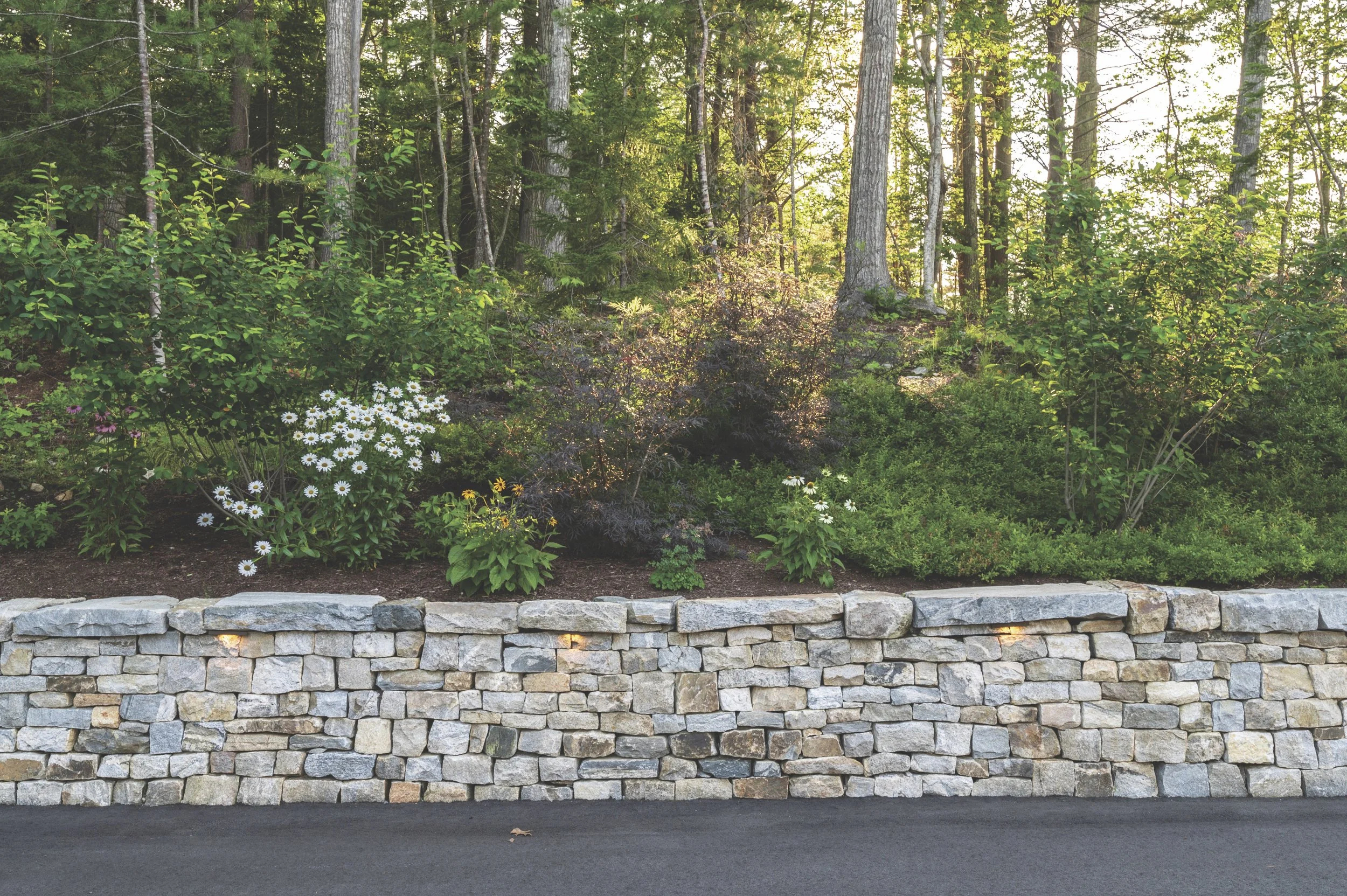
| Terrapin Landscape’s hardscape construction projects start with the land—its shape, its features, and vision for use. Terraced retaining walls and stonework add texture and life to each property.
Forests were landscapes cleared for lumber, pastures were developed for farming, and the stones were stacked along the perimeters of these pastures as boundary markers.
Harsh winters and deep frosts pushed more stone to the surface as forests and root systems were eliminated, the clearing process repeating itself year after year. The prevalence of such an abundance of stone was due to the existence of a glacial ice sheet that began melting 15,000 to 20,000 years ago, which left shattered bedrock (often referred to as glacial till) in its wake.
Though there’s evidence of stone wall construction as early as the 1600s, they were sparse until an agricultural evolution took shape after the War of 1812. Merino wool production boomed, due in large part to demand but also because the sheep were uniquely capable of foraging along the rocky landscape of our region.
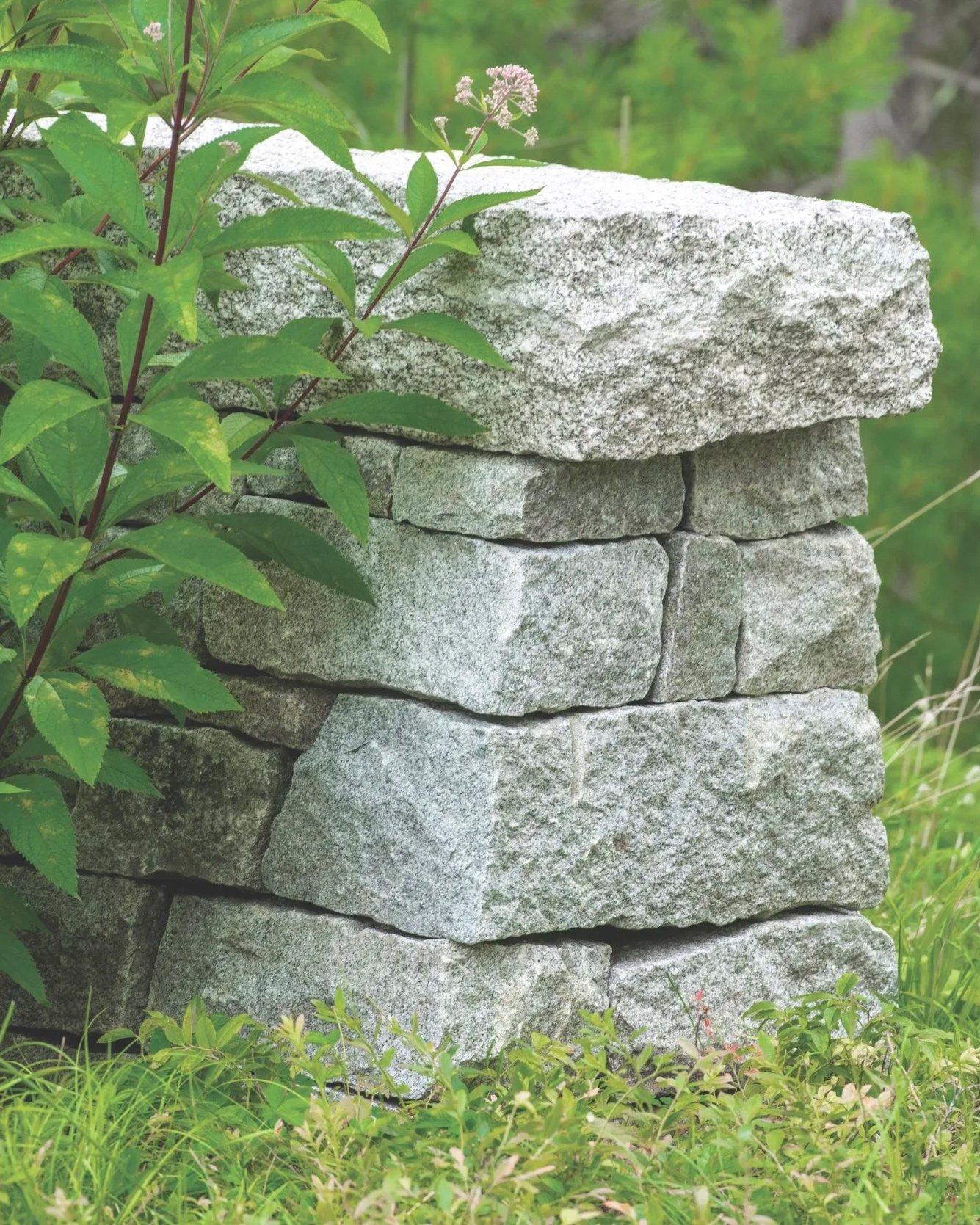
New England farmers seized on the boom and developed a more thorough network of pastures, tilling up more stone and constructing stronger stone walls needed to contain the flocks as the population of sheep in the Northeast grew to over 1.4 million strong. These walls were built using methods inherited from European ancestors, adapting these traditional styles (single walls/dykes, double-sided walls and retaining walls) to the igneous and metamorphic stone that surrounded them. Stone became a vital building material for other aspects of New England living as well. The glacial field till was used in retention walls for foundations on barns and storage buildings. Granite bedrock was quarried and utilized for its ability to be split cleanly, making a product ideal for house foundations, entrance steps and cobble roads.
As the Agrarian Era gave way to industrialization, the pastures of New England grew dormant, and nature reclaimed her hold on the landscape. The end-result is what we see in our present day: walls that once defined vast pastoral land are now engulfed in forests, settled along quiet, rural roads or tucked unperturbed into backyards.
Thankfully, the impact of stone on our locale never became a forgotten relic and the conservation of its history has been a focal point of communities across New England for more than the last half-century.
Stonework as a profession saw a resurgence as the population began to grow and homeowners sought to recreate history in their own yards. With its abundance and regionally rich history, stone has been a practical building material for landscapes around New England for decades.
Start your own story with a stone wall that can last for generations. |
Stone masons, intent on reviving the aesthetic of the former pasture walls, have helped grow the craft of dry-stone walling and developed a strong community of like-minded craftspeople that now spans across the country. Once considered purely for their utilitarian function, stone walls are now abundant in residential landscapes as aesthetic features as well. Our local stone bounty is no longer viewed purely for its function but also for its form, and that has allowed for the evolution of a burgeoning stone industry as a craft and an artform.