

Central Maine’s Cosmic Treatment
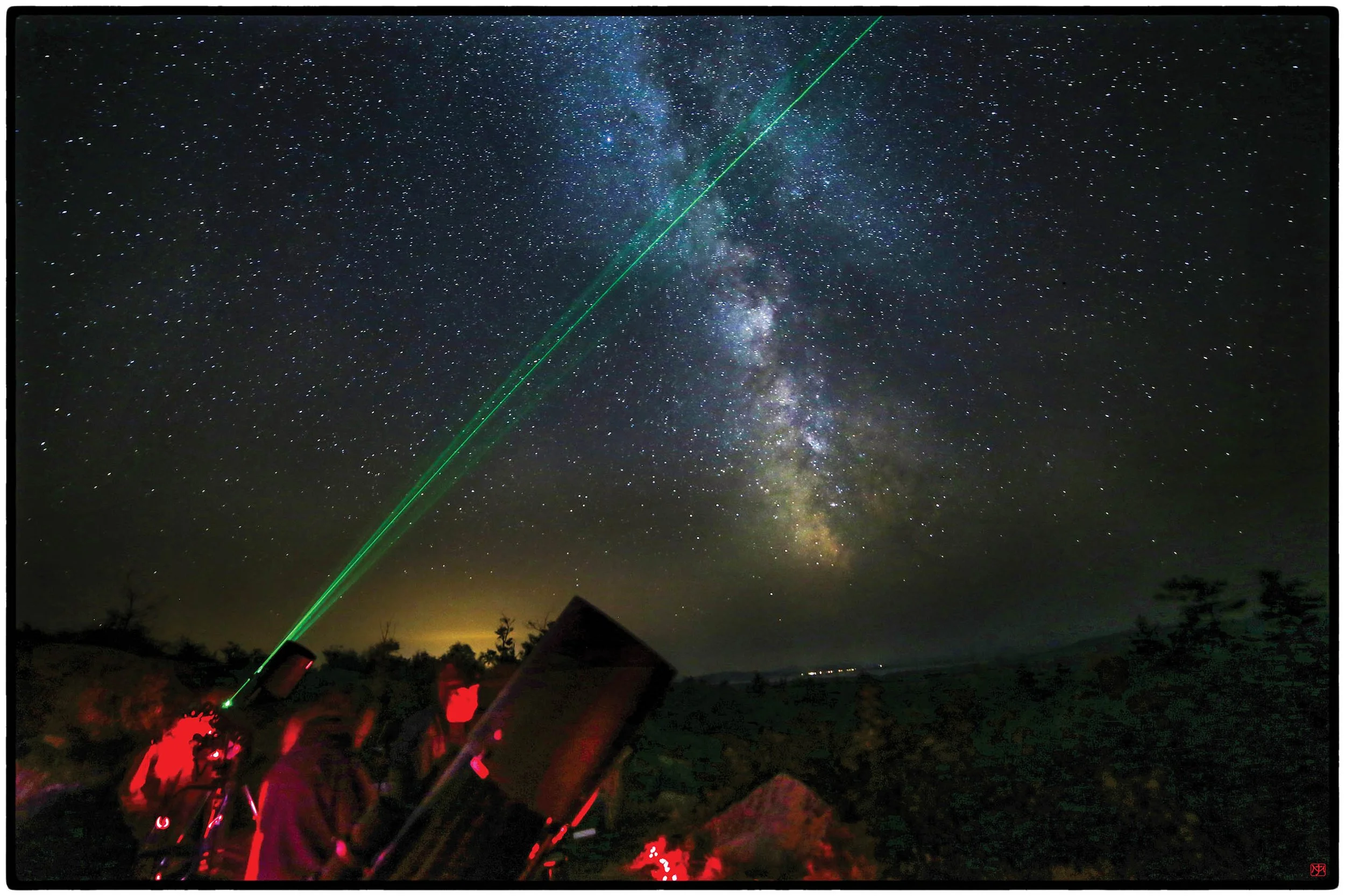
Worth the Drive
With noctourism on the rise,
Maine is poised for a nocturnal renaissance
words by michael colbert
photography by john meader
Out-of-state visitors have a new reason to add Maine to their travel bucket lists, but it requires ditching the famous coastline, heading inland, and abandoning any fear of the dark.
“Maine has the darkest skies east of the Mississippi,” says Shawn Laatsch, director of the University of Maine’s Versant Power Astronomy Center. “Given how densely populated the East Coast is—and when you have great population density, you have a lot of lights—we’re very lucky.”
A Wisconsin native, Laatsch’s story with the night skies began on fishing trips with his grandfather, during which he found the Big and Little Dippers. When he was in second grade, a visit to the local high school’s planetarium redirected the course of his life.
“The person running it asked if anyone wanted to help, and I raised my little hand,” he remembers. “He put me behind the console, let me turn down the lights, and turn on the stars. That really got me hooked.”
Laatsch has traveled around the world studying the night sky and supporting outreach efforts with various communities. Prior to his post at UMO, Laatsch worked with the International Planetarium Society, built and installed a planetarium in the Netherlands, and posted for eight years at the Mauna Kea Observatories in Hawaii, where he helped bring their astronomical data into the digital world.
The most important thing about any stargazing destination is light: the farther away from any illumination, the better.
“Maine is a sparsely populated state, so most people can drive an hour and find some really dark skies,” he says. “If you live in New York or Boston, that would be a multiple hour drive to find a dark sky location and do some stargazing.”
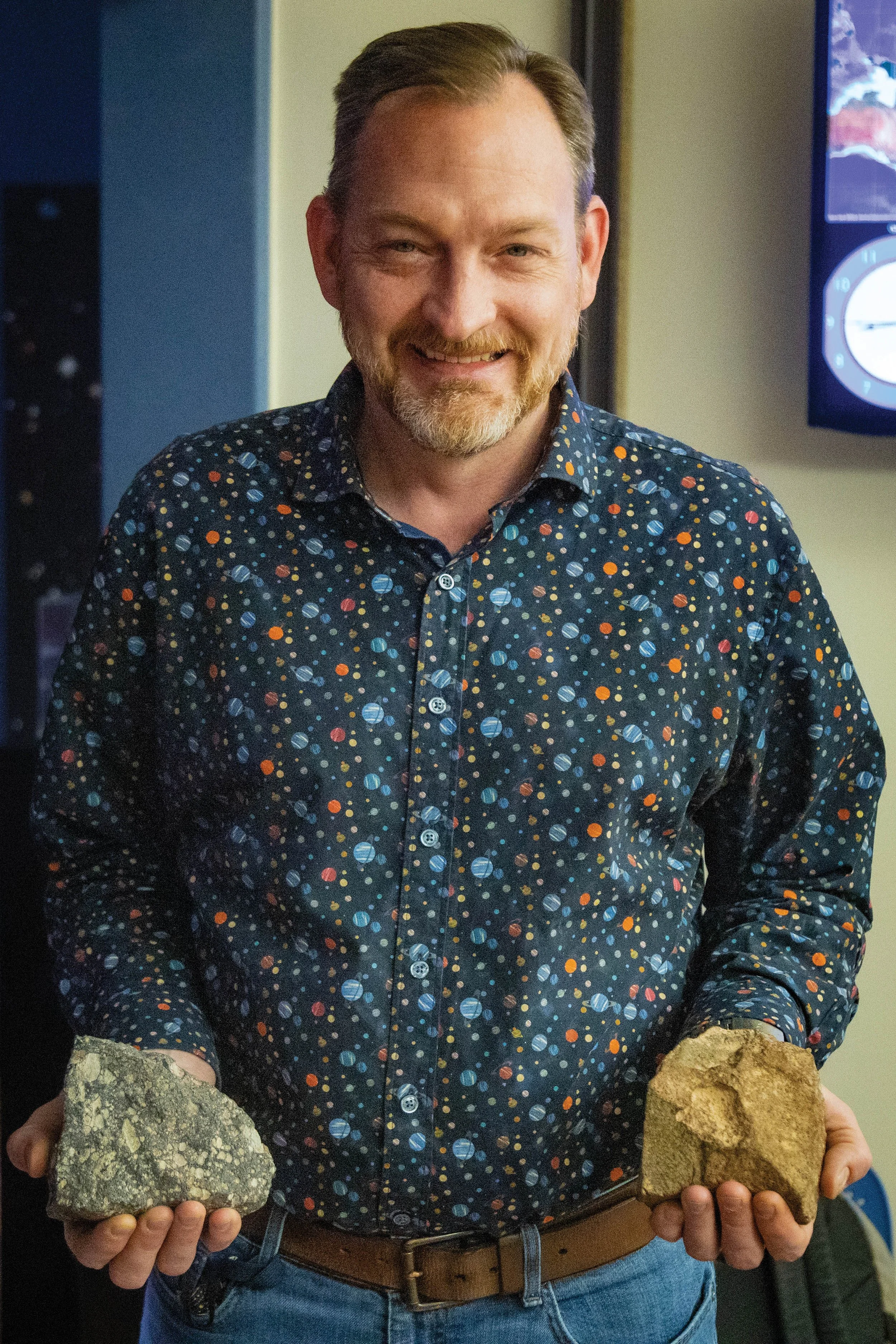
Laatsch shared some guidance—and prime locations—for those ready to explore.
“I look at it as crawl, walk, run,” says Laatsch. “Everyone has to start somewhere.”
Crawl in Orono
“‘Crawling,’ in terms of astronomy, is learning the constellations,” Laatsch says. “Teaching yourself how to find not just the Big Dipper and Little Dipper, but going beyond that to star hop from one to another.”
For novice stargazers looking to study up, Laatsch recommends Stellarium, a free desktop planetarium program, and Heavens-Above.com, which allows users to generate star charts for their location and track satellites orbiting overhead.
Hotel Ursa, a newly opened boutique hotel on the University of Maine’s campus in Orono, runs a monthly stargazing program for guests in partnership with the university. On clear nights, groups meet for an orientation at the Versant Power Astronomy Center, then Laatsch brings them to the Hirundo Wildlife Refuge to explore. Only 20-minutes up the road, it’s an ideal location for a nocturnal tutorial.
Laatsch hauls a portable telescope into the field and gives a guided tour of the constellations, nebulae, and star clusters. I joined in late July and learned about Cassiopeia, Andromeda, and Scorpius. My favorite was NGC 457, the “owl cluster”—two piercing eyes staring back at me from the cosmos, lightyears upon lightyears away.
Walk in Katahdin Woods and Waters
“Binoculars are your ‘walking,’” says Laatsch. “The constellations are your guideposts to finding things, then binoculars help you search a bit deeper. With binoculars, you can see the moons of Jupiter, a number of star clusters, and nebulas.”
Telescopes are a bigger investment, and many casual stargazers may already own binoculars for birdwatching or sporting events.
“The key thing with binoculars is having them on a tripod to stabilize them,” he says. “Even if you have the hands of a brain surgeon, it will shake, so a tripod makes a big difference.”
“In the big cities, you can see the moon, and a pair of binoculars can show you some beautiful craters and mountain ranges. It’s something that anyone can do, and if you get to a dark sky location, you can see so much more.”
Continuing an hour and a half inland from Hotel Ursa is the national monument Katahdin Woods and Waters, a dark-sky preserve designated by the International Dark Sky Association. At a park like this, stargazers have enhanced visibility as the preserve seeks to mitigate the amount of light emanating from the surrounding community.
Run with the Appalachian Mountain Club
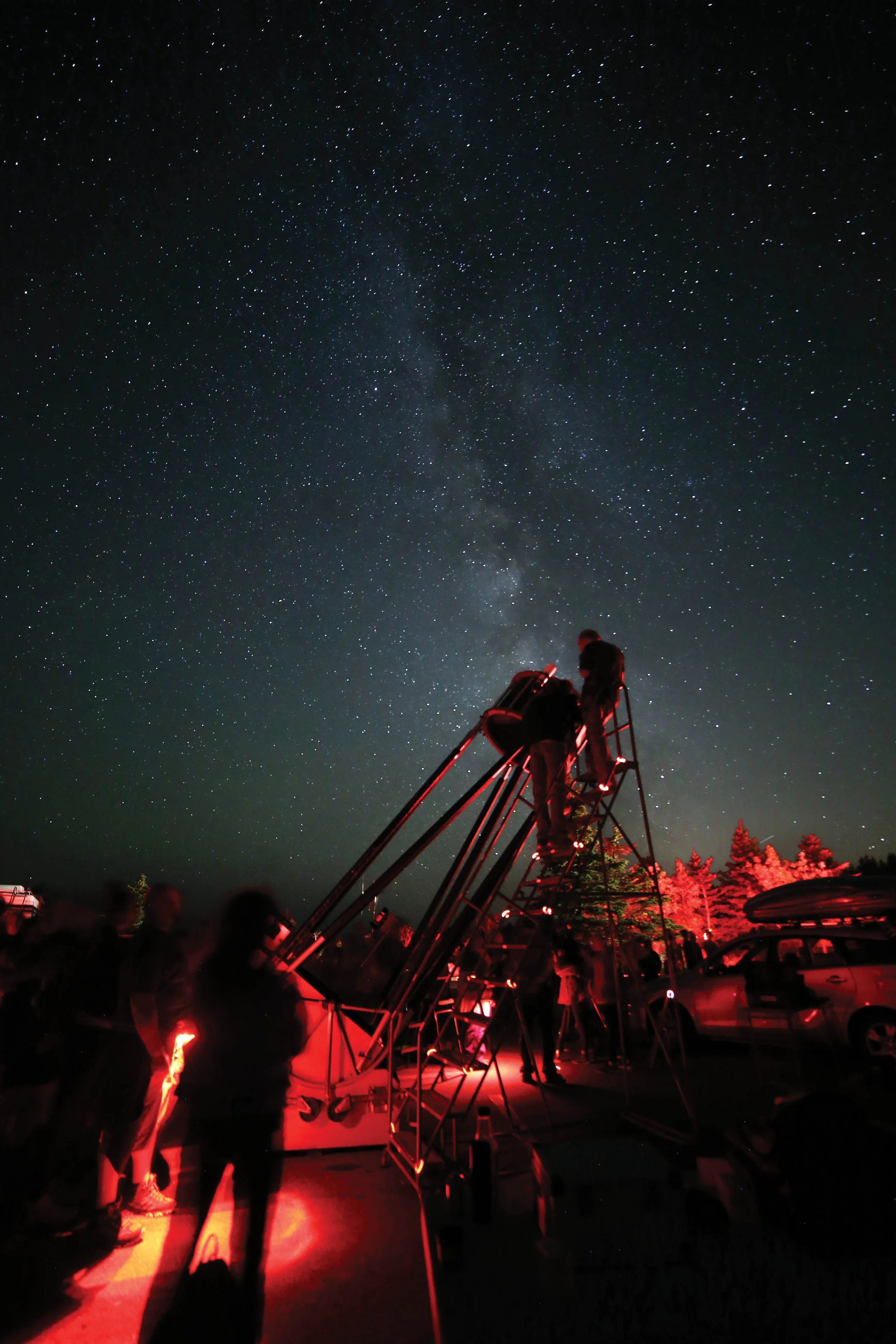
After developing some comfort with binoculars, it’s time to “run” and use a telescope. Laatsch recommends prioritizing diameter over any advertised magnification capability—the greater the diameter, the more light-gathering power.
The Appalachian Mountain Club in Greenville exists on “another level.” As a Dark Sky Park, they’re required to collaborate with their communities, cap the number of lights, and shield them.
“When you get up to AMC, the skies are as dark as some places in the desert, Montana, or the mountains,” says Laatsch. “The skies are pristine and really beautiful.”
Laatsch also has some practical tips. Stargazing is much more stationary than cross-country skiing or snowshoeing, so getting out in winter requires warmer clothes than expected. And in summer? Bug spray is essential.
Laatsch sees that astronomy offers something for everyone, whether through a local club, or the same place where he got his start—a school planetarium.
“The bulk of planetariums in the United States are actually in K–12 schools and university settings,” he says. “If you can’t get to dark skies, they can recreate the night sky. Sometimes that’s a good way to get started on the constellations, and then take the next step.”
Ready to get out there?
Annual meteor showers provide a blockbuster show. The Perseids fall every year in the middle of August, the Orionids at the tail end of October, and the Leonid meteor shower in November. While most years, 15 to 20 meteors might be visible an hour, every 33 years the Leonid shower storms with thousands of meteors an hour.
Towards the end of the year, Saturn, Jupiter, and Venus will return to the night sky.
Maine was in the path of totality for the 2024 solar eclipse, and new aficionados will have to travel for the next few. The 2026 total eclipse will pass in totality through Greenland, Iceland, and Spain. In 2027, an eclipse will last over six minutes and will be visible in totality farther afield—in Luxor, Egypt. While Maine will not be in the path of a total eclipse again until 2079, the nocturnal sky show continues to inspire each and every night.
Follow the documentary on Houlton’s Full Solar Eclipse journey by visiting amomentinthesunmovie.com.
